Quick view through Data Structures
In our daily lives, we deal with a lot of data, right? I mean both the scale of it and the kinds of operations we perform on it. So naturally, how we group, organize, and store that data really matters.
Think about a map. It contains roads, buildings, places, fastest routes. Basically tons of information. But all of that data isn’t just thrown together randomly. It’s organized in a geometric way so we can access it easily and make sense of it. That kind of data needs a special structure to be useful.
Now think about a sales dashboard. In a single view, it might show customers and the products they’ve bought. It’s all sales-related data, but behind the scenes, that data needs to be stored and organized properly so we can retrieve it efficiently.
Even in our own computers, the way data is stored on hard drives follows certain structures.
And then, compare all that to a simple list of numbers, that’s a completely different kind of data with different needs.
So basically, data structures are ways of organizing and storing data, and the choice of structure depends on the scenario, just like in the examples above.
Two Ways to Look at Data Structures
When we talk about data structures, we can think about them in two main models:
- Logical Model
This is the abstract, mathematical way of describing a data structure—without worrying about how it’s actually implemented. - Implementation
This is the real, practical way we build that data structure in code.
The interesting part is, if you understand the logical model well, you can implement it in any programming language, not just one.
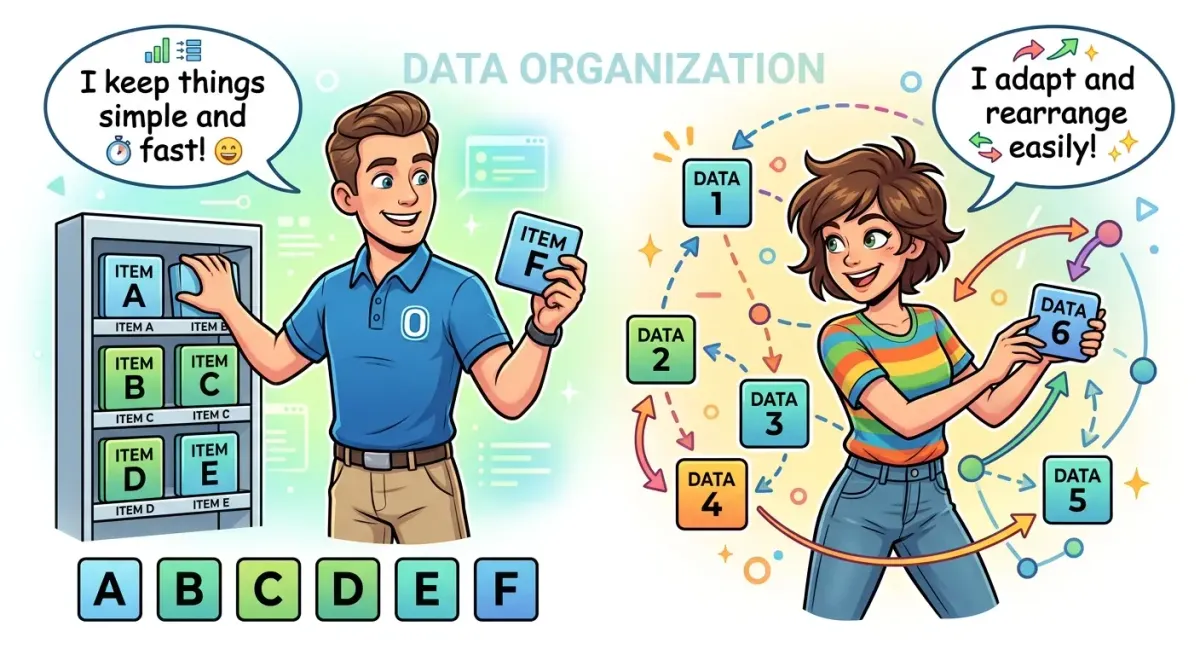
If you think about an array, it’s pretty straightforward. You store items in a sequence, and you can access any element directly using its index. Simple, fast, and predictable.
But when it comes to a linked list, it’s a bit of a different story. Instead of storing elements next to each other, each element points to the next one. So accessing data isn’t as direct but inserting or removing elements becomes much easier in certain cases.
And that’s exactly the point different structures are optimized for different situations.
There are many data structures developers use every day, such as:
- Arrays
- Linked Lists
- Stacks
- Queues
- Graphs
- Trees
- Hash Maps
And that’s where things start to get really interestin,because each of these solves a different kind of problem in its own way.