Vectors in mathematics vs physics
Today I finally sat down and tried to understand vectors properly… not just to pass an exam, but to actually get it. And honestly, I wish someone had explained it to me like this years ago.
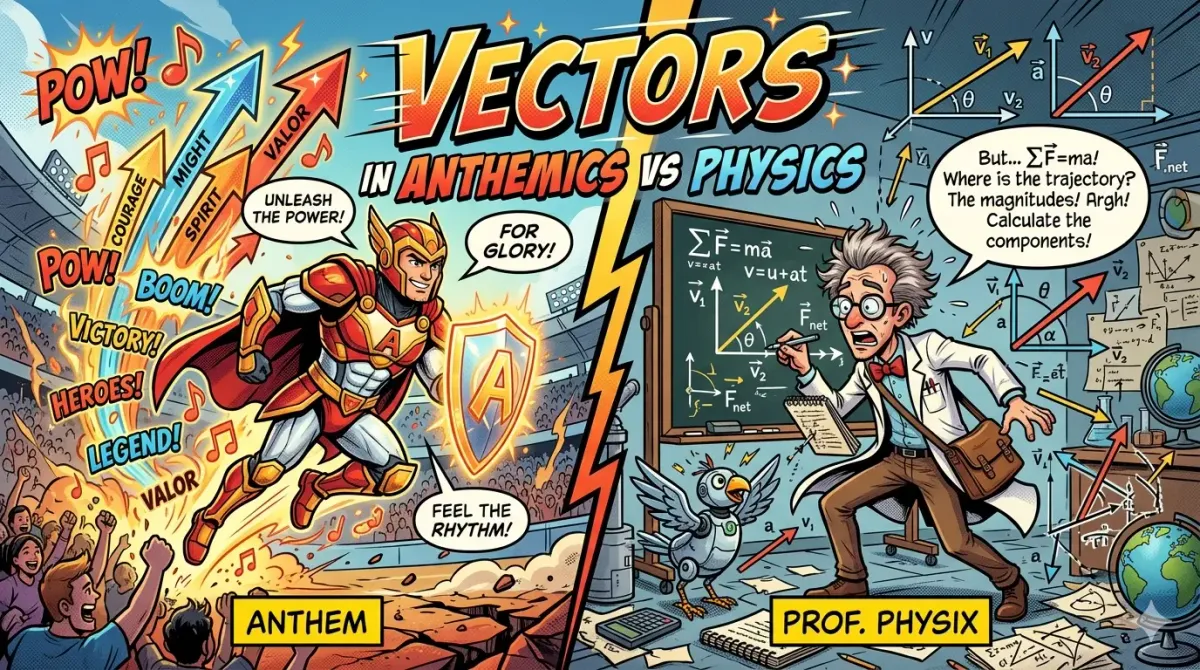
Back in school, vectors were introduced as arrows. In physics, they told us: “a vector has magnitude and direction.” So I imagined forces, velocities, little arrows flying around. It made some sense… but only in that context.
Then in maths, suddenly vectors became things like (2, 3) or (1, -1, 4). No arrows. No direction. Just numbers in brackets. And I remember thinking: Wait… are these even the same thing?
Turns out , they are. Just seen from two different angles.
The physics view is like looking at the world movement, force, direction. The maths view is like looking under the hood structure, components, computation. One helps you visualize, the other helps you calculate. Same idea, different language.
The real shift for me was this,
A vector is not about arrows or brackets.
A vector is something you can add and scale.
That’s it.
Everything else, arrows, coordinates, matrices, even functions are just different forms that obey those rules.
That’s when things got interesting.
Because then I realize, vectors don’t have to be arrows in space. They can be:
- lists of numbers
- polynomials
- functions
- even signals
As long as you can combine them and stretch them, they live in what we call a vector space.
And a vector space is basically a “playground” where:
- adding two objects keeps you inside
- scaling an object keeps you inside
- and everything behaves consistently(according to axioms)
That’s why (x, y) works.
That’s why real numbers work.
That’s why even weird things like functions work.
Looking back, I think the confusion came from learning representations before understanding the idea.
We were shown:
- (2,3)
- 2i + 3j
- column vectors
…but never told clearly that these are just different ways of describing the same thing.
Now it finally clicks:
Vectors are not about what they look like.
They are about what they can do.
And honestly… that realization made the whole topic feel less like memorizing formulas and more like understanding a system.
Still learning, but this time it actually feels like I’m building something solid.