A Simple Trick to Avoid Messy DynamoDB Designs
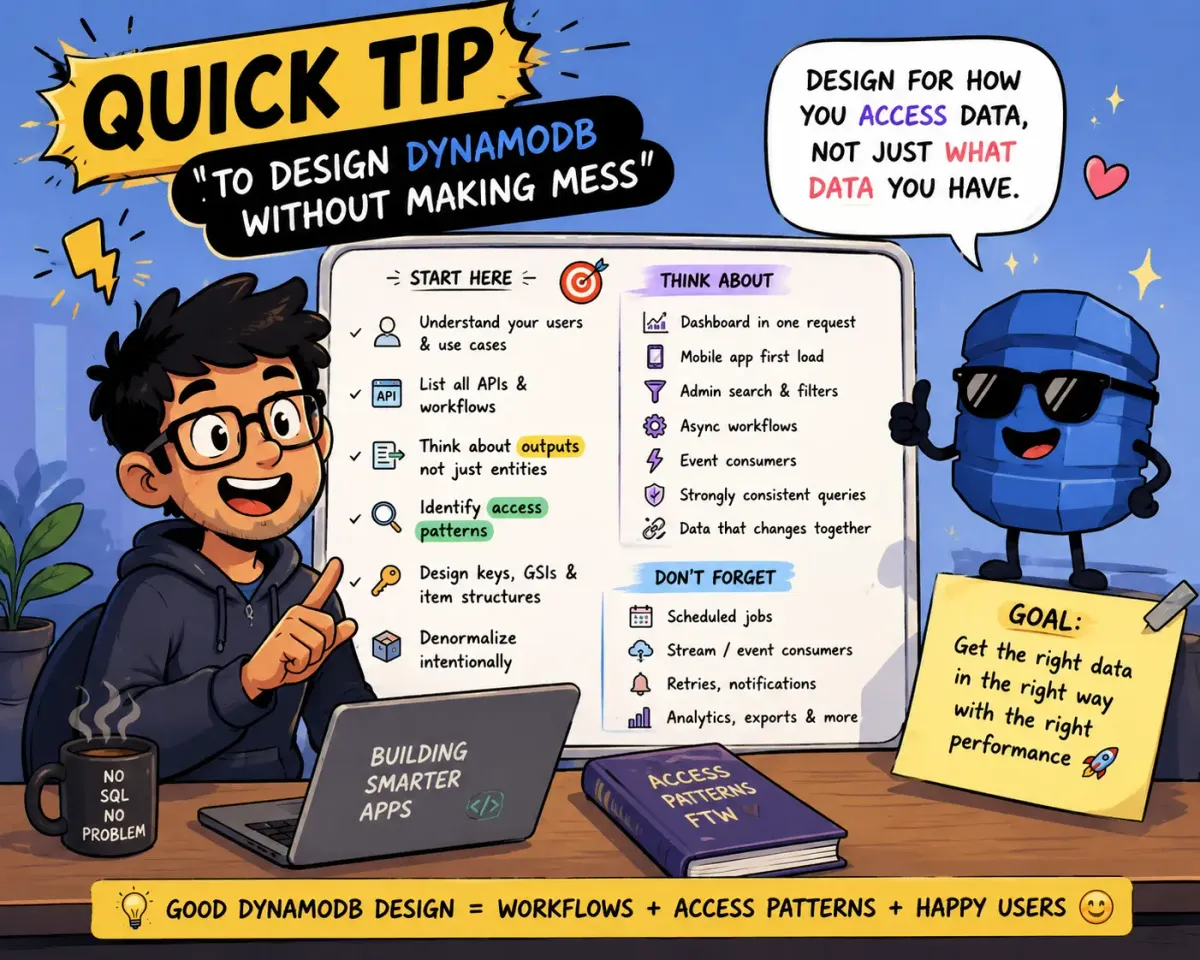
One thing I learned while working with DynamoDB single table design is that it should not start only from entities and relationships like traditional relational databases.
In single table design, multiple entities are usually stored in the same table, and the structure is mainly optimized around how the application reads and writes data efficiently instead of separating everything into different tables.
Because of that, I feel the biggest factor in DynamoDB design is understanding what data we going to input and get as out puts. Mainly outputs 😄.
People already know access pattern the thing in dynamodb but lot of people start by identifying entities like,
- Users
- Orders
- Products
- Payments
and then try to build access patterns just only based on entities.
But from my experience, that can sometimes lead to messy designs, unnecessary GSIs, unrelated access patterns mixed together, and future rework.
Instead, I think it’s better to first understand the actual workflows and outputs of the system from both backend and frontend perspectives. Then comes the db designing part.
From a frontend point of view, you need to think like this:
- What does the dashboard need in one request?
- What does the mobile app load first?
- What does the admin panel search by?
- What data should be shown immediately on screen?
- What data can be lazy-loaded later?
- What filters or sorting does the UI depend on?
From a system and workflow point of view:
- What APIs do we need?
- What data is loaded most frequently?
- What backend workflows exist?
- What workflows happen asynchronously?
- What event-driven processes need access to data?
- What event consumers need partial data?
- What scheduled jobs or stream consumers exist?
- What operational queries will support teams need?
- What queries must be strongly consistent?
- What data changes together?
- What can be possible future requirenments?
Sometimes frontend requirements are only a small part of the system. Internal processes like notifications, retries, reconciliation jobs, analytics exports, payment processing, or async workflows also create important access patterns.
After understanding all those scenarios, it becomes much easier to design its key structure including Primary and GSIs.
At that point, access patterns become much clearer because we already understand:
- the inputs
- the outputs
- the workflows
- how data moves through the system
- and how the UI actually consumes it
For me, good DynamoDB design is more about understanding workflows, API contracts, and access patterns than just modeling entities like a traditional SQL database.
Entity relationships still matter, but to unlock maximum performance of DynamoDB we need to focus on access patterns instead of driving the entire design.